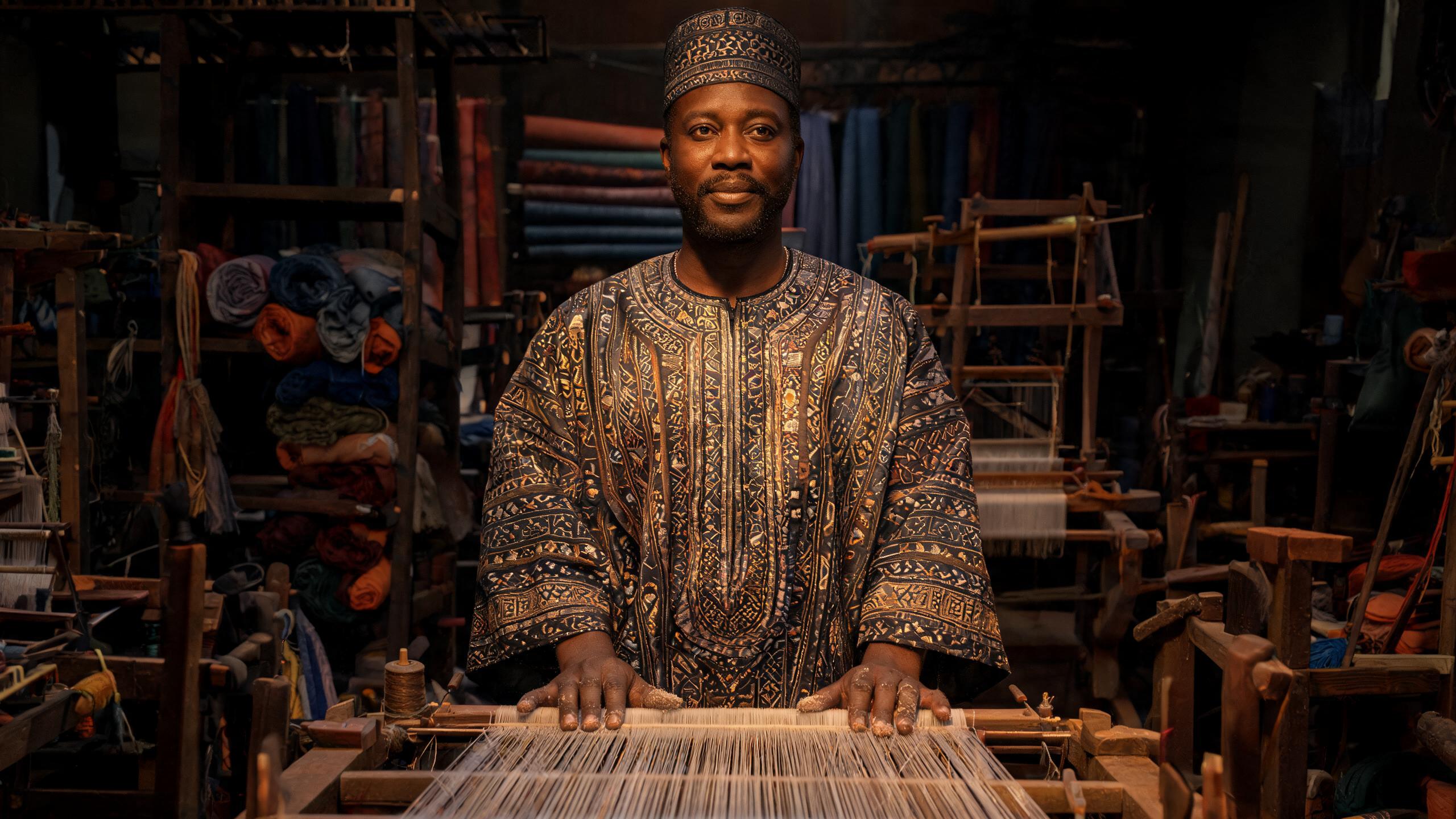
Alahun The Weaver arrives as one of the most talked about Yoruba-language films of the year, assembling a cast led by Odunlade Adekola alongside Tomi Ojo, Moshood Fattah and Omowunmi Dada. Promoted as a fantasy steeped in Yoruba folklore, the film centers on the figure of Alahun, a master weaver whose craft is tied to memory, destiny and the unseen threads that connect people to their past.
Odunlade Adekola takes on the title role of Alahun. The character is portrayed as a solitary artisan whose looms do more than produce cloth. His tapestries capture moments in lives, mend broken bonds and conceal secrets that others want to expose. Omowunmi Dada appears as Eniola, a determined woman who seeks Alahun out for help. Her arc anchors the human stakes of the story and offers a view into the social world surrounding the weaver. Tomi Ojo plays Chief Sola, a community leader whose ambitions bring him into conflict with the weaver, while Moshood Fattah is cast as Ade, an earnest apprentice learning the legacy and responsibilities of the loom.
Together the four actors present a mix of experience and fresh energy. Odunlade Adekola brings a steady screen presence and familiarity with Yoruba cinema. Omowunmi Dada contributes a layered performance style that has made her a notable figure across languages. Tomi Ojo and Moshood Fattah add depth to the ensemble, representing older and younger perspectives within the film's social fabric. The casting signals an intention to engage diverse viewers who follow each performer for different reasons.
Production sources describe the film as a visual and sonic exploration of craft. Cinematography focuses on close studies of the loom and hands at work, using texture and light to create a tactile feeling of making. Costumes are central to the film's visual language. Designers worked with traditional weavers and textile experts to recreate authentic patterns and techniques. The soundtrack blends indigenous percussion, voice and ambient scoring intended to evoke ritual and place. Visual effects are used selectively to suggest the supernatural nature of Alahun's work rather than to overwhelm the practical craft on screen.
The creative team emphasized language and cultural detail. The film is primarily in Yoruba with subtitles planned for wider release. Story elements draw on Yoruba cosmologies and proverbs, folding them into a narrative about responsibility, memory and community. The weaving metaphor operates on multiple levels, connecting individual lives to communal history. Directors and music directors sought local consultants to ensure cultural motifs were handled with respect.
Filming locations include identifiable townscapes and rural settings that reflect the world in which traditional weaving is still practiced. Scenes set in market squares and family compounds contrast with sequences that take place in the weaver's studio. The production design highlights domestic spaces where textile arts are part of everyday life. On set, the cast engaged with real weavers and apprentices to learn technique and mannerisms. Those practical details inform performances and aim to give the film a grounded quality even as it leans into fantasy.
Early marketing materials emphasize the film's spectacle while also promoting the human story at its center. Trailers present images of patterned cloth expanding to reveal visions, a village longhouse, and confrontations where private craft becomes public concern. Publicity also points to a generational dialogue, showing how knowledge is passed from one hand to another and how new technologies and ambitions complicate that transfer. Producers have signaled plans for a national theatrical release later in 2026 and are exploring screenings at regional film festivals to reach international audiences with interest in indigenous-language cinema.
The film arrives at a moment when Nigerian filmmakers are widening the genres they work in. Fantasy rooted in local belief systems has been a route to reimagining history and social questions without losing cultural specificity. Alahun The Weaver positions itself within that movement, using a single craft as the stage to discuss broader themes of power, memory and moral accountability. It also provides a platform for actors to explore roles that marry traditional performance styles with contemporary cinematic techniques.
Alahun The Weaver will be judged on several fronts. Audiences and critics will look at how effectively the film blends folklore with a coherent plot, how convincingly the visual language conveys the magical elements, and how the principal actors inhabit their roles. There is also the practical question of distribution and how the film will reach viewers outside of its primary language area. If it succeeds, the film could strengthen interest in Yoruba-language productions and encourage more stories that draw directly on indigenous crafts and cosmologies.
Roundup opinion: The convergence of Odunlade Adekola, Tomi Ojo, Moshood Fattah and Omowunmi Dada in Alahun The Weaver creates a promise of range and depth. The film offers a rare chance to see a craft form treated as both a technical practice and a narrative device. For viewers curious about how folklore and contemporary filmmaking can intersect, this project will be one to watch. Its success will depend on storytelling discipline and the ability of the creative team to translate culturally specific motifs into a cinema language that resonates beyond local boundaries.








0 Comments