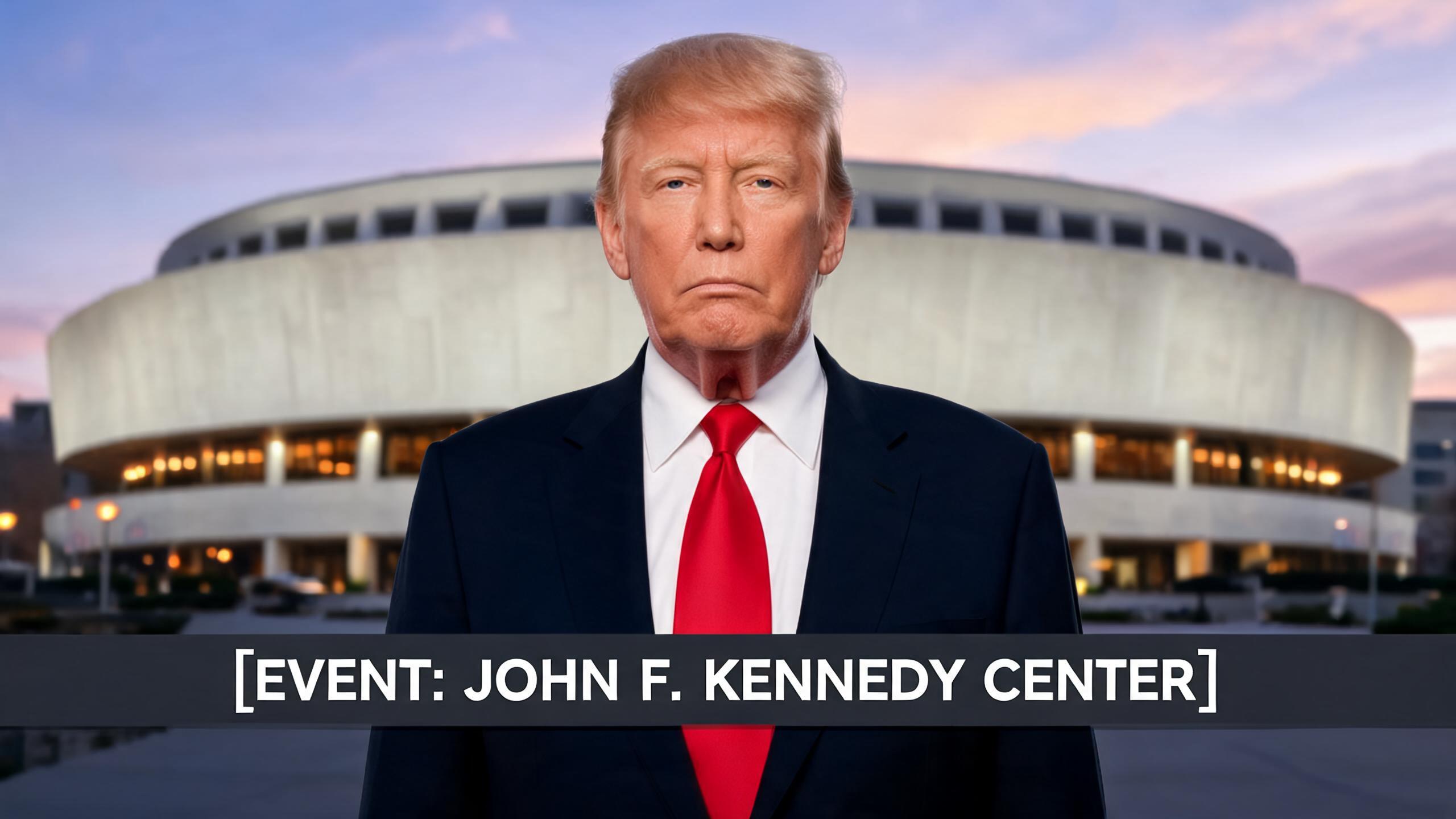
Former President Donald Trump took an unexpected media tack after his election defeat when a subtitled commentary feed associated with his team appeared during a high-profile Kennedy Center broadcast. The overlay presented short captioned observations timed to the program, attracting attention from viewers and cultural institutions alike.
The subtitled feed arrived as the Kennedy Center broadcasted a gala honoring performing artists. Rather than appearing on stage or in an official capacity, the former president opted for a digital presence. The captions ran at the bottom of the broadcast window and offered terse commentary that paralleled the program without interrupting the original audio track. Viewers first noticed the overlay during a widely viewed performance and shared clips online, prompting broader scrutiny.
Staff at the Kennedy Center said the organization did not authorize the subtitled overlay and that the broadcast itself proceeded as planned. Technical teams described the overlay as an independent stream layered onto existing broadcast feeds by third party software or by viewers using a separate captioning track. In other cases, social media streams carrying the gala included the subtitled track embedded by accounts that identify with the former president.
Media technologists who reviewed clips said the approach is technically straightforward. Modern streaming platforms allow third party caption and subtitle files to be added client side. That means a subtitle file can run in parallel to authorized closed captions, and anyone watching through a particular platform or plug in can see the overlay even though the official broadcast remains unchanged. The result is a visual commentary that feels concurrent with the event while bypassing the event curator.
Reaction among viewers and arts professionals varied. Some saw the subtitled feed as a quirky stunt, a digital echo of political campaigning adapted for cultural moments. Others questioned whether a political actor should insert commentary in this manner into an artistic program that was not political in design. At least one viewer who encountered the overlay described it as jarring, while another said it added a layer of entertainment to an evening already framed as spectacle.
Representatives associated with the former president framed the subtitled material as a way to reach an audience that might not otherwise engage with his perspective. They emphasized that the track did not alter the underlying broadcast audio or the program content. The Kennedy Center highlighted the independence of its programming and reiterated that any third party overlay is not an endorsement and is not under the center's control when distributed on external platforms.
The episode underscores an evolving intersection of politics, technology, and cultural institutions. Subtitles and captions began as accessibility tools but now have become versatile instruments for commentary, translation, and framing. In recent years, overlays have been used to provide translations, contextual notes, and fact checks. The subtitled feed in this instance repurposed the same mechanism for political messaging in the context of an arts event.
Legal and platform policy experts point out that whether such overlays violate broadcast rules depends on the distribution method. When a third party adds a subtitle file locally to a stream they share, enforcement options for the host broadcaster can be limited. Platforms hosting streams that include the overlay may intervene if content violates their terms. For rights holders and cultural organizations, the incident raises fresh questions about protecting the integrity of live presentation while navigating an increasingly layered digital environment.
For the Kennedy Center, the situation added an unexpected moment to its program night. The center regained attention as viewers debated boundaries between cultural celebration and political expression. For the former president, the subtitled feed represented one among several post-defeat communication methods being tested as his team explores new ways to stay present in national conversation without the direct platform that an official role provides.
The subtitling episode may also prompt artistic communities and broadcasters to consider practical responses. These could include platform negotiations to limit third party overlays during live streams, clearer viewer guidance about optional caption tracks, and technical measures to make authorized captions more prominent. Cultural organizations may also weigh statements that clarify their role and the independence of their programming.
This occurrence illustrates how modern media ecosystems allow unconventional forms of presence. Subtitles that once served only accessibility functions can now carry commentary and promote visibility in spaces that were previously outside the reach of direct political messaging. The interplay between a major cultural institution and an outside commentary stream highlights how broadcast boundaries are shifting in the internet age.
As the story circulates, stakeholders on both sides are likely to reassess how cultural broadcasts are protected and experienced. The Kennedy Center plans to review the incident internally while streaming platforms evaluate community responses. For audiences, the event is a reminder that live cultural broadcasts are happening within a broader media landscape where multiple overlays can change what viewers see during a single program.



0 Comments