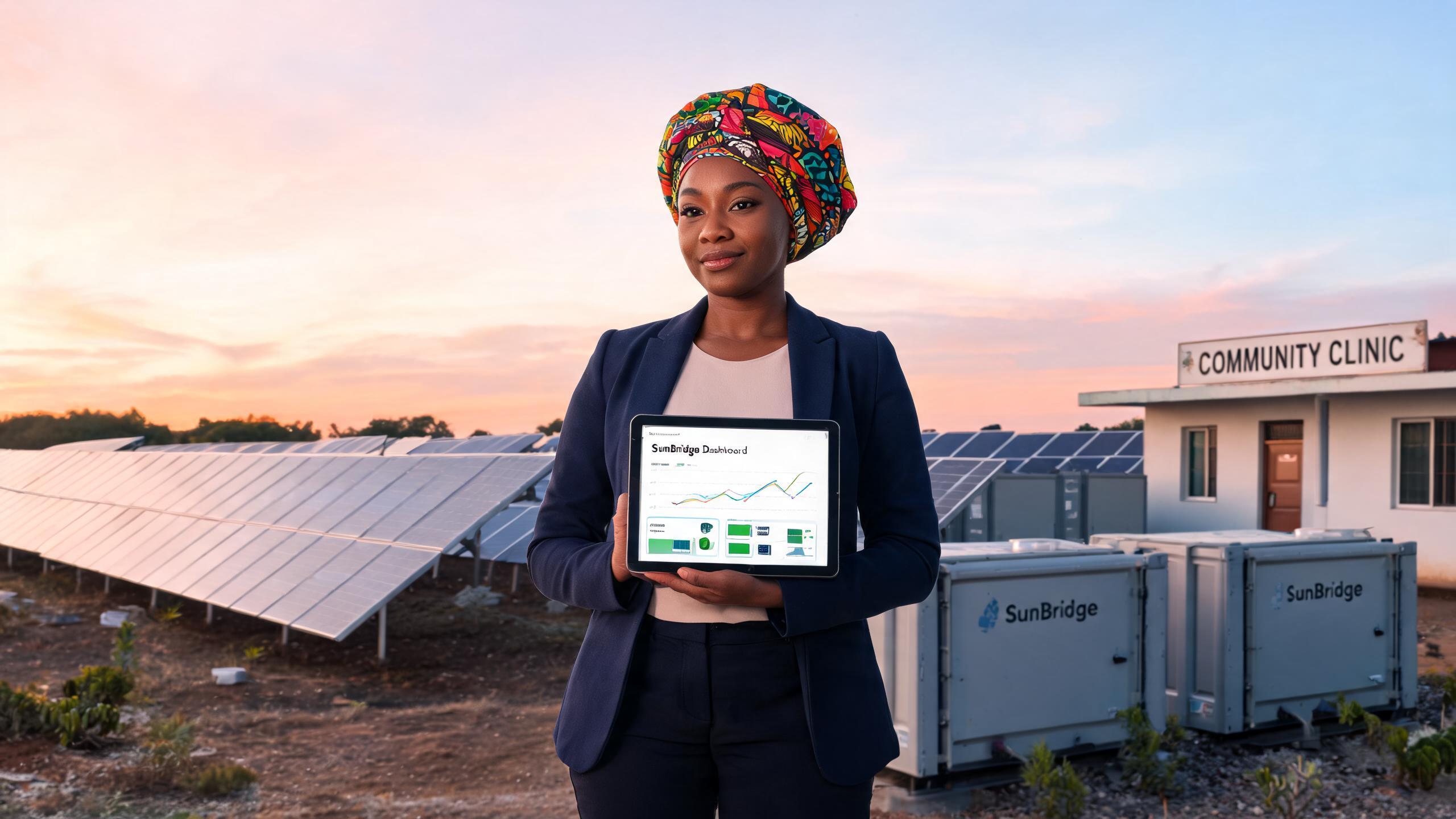
SunBridge, a Lagos-founded renewable energy company, has closed a $50 million funding round aimed at accelerating the rollout of solar-plus-storage microgrids in West and East Africa. The financing marks a major step for the company as it moves from pilot projects into wider commercial deployment, with an explicit focus on reliable power for towns and agricultural hubs that remain largely off-grid.
Founded in 2018 by CEO Amina Koné and CTO David Mensah, SunBridge began as a pilot installer of rooftop solar systems before pivoting to community-scale microgrids in response to persistent outages and the high cost of diesel generation. Koné said the new capital will enable SunBridge to deploy more than 200 microgrids over the next three years, each sized to serve between 300 and 2,000 households and local small businesses.
“Nobody should have to manage their day around when the lights are expected to return,” Koné told reporters. “Our goal is to deliver reliable, affordable power that supports education, health services and small enterprise. This financing lets us scale proven systems and partner with local teams to maintain them.”
The round was led by Nile Capital Partners, an Africa-focused investment firm, with participation from several development-oriented funds and regional investors. Nile Capital’s managing director, Ama Boateng, said the firm’s due diligence focused on technology performance, the company’s track record of community engagement and a pipeline of ready-to-build sites.
“SunBridge combines resilient hardware with software that improves uptime and payment collection,” Boateng said. “That mix reduces risk and makes community microgrids investable at scale.” The company’s technology integrates modular lithium-ion battery banks, solar arrays sized to local demand profiles, and a cloud-based energy management platform that monitors generation and consumption in real time.
SunBridge’s expansion plan includes partnerships with local governments and utilities to ensure regulatory alignment and to explore hybrid solutions that support the main grid where it exists. In several pilot communities, the company negotiated co-operation agreements that allow microgrids to supply critical facilities such as clinics and water pumps while selling surplus power to nearby businesses.
David Mensah, the company’s chief technology officer, described the technical approach as deliberately modular. “We design systems that can be expanded as demand grows,” Mensah said. “That lowers upfront costs for communities while giving space for enterprises like cold storage and milling to come online. The software also provides analytics to help local operators manage load and predict maintenance needs.”
SunBridge has emphasized local hiring and training as central to its scaling strategy. The company plans to recruit and train more than 1,200 technicians and community managers across its target markets, offering skills development in system installation, monitoring and customer service. Koné said the focus on local capacity helps ensure long-term operational reliability and creates jobs beyond the immediate benefits of electrification.
The company faces familiar challenges for energy startups in the region: navigating fragmented regulations, securing suitable sites and managing currency and payment risks for customers. SunBridge has adopted a pay-as-you-go model that allows households and businesses to purchase energy by mobile payment, while offering longer-term contracts for anchor customers like schools and clinics to stabilize revenues.
Local officials in towns where SunBridge operates have welcomed the projects. In a market town where the company completed a pilot last year, clinic staff reported fewer disruptions during night-time emergency procedures and local shop owners said longer operating hours increased daily revenue. Residents also cited reduced spending on kerosene and diesel, with environmental benefits from cutting fossil fuel use.
Investors and industry observers will watch whether SunBridge can sustain technical performance and customer retention as deployments scale. The firm’s model—combining modern hardware, cloud monitoring and local teams—echoes approaches used by successful peers but will be tested by broader regional rollouts and seasonal demand fluctuations.
For now, SunBridge is moving into a phase where execution matters most: building multiple sites simultaneously, onboarding local partners, and ensuring finance is translated into lasting access. If the company meets its deployment targets and maintains system availability, the result could be meaningful progress for thousands of households and dozens of small enterprises that depend on reliable power.
The new funds are earmarked for equipment procurement, grid site development, workforce training and expanding the company’s operations centre, which coordinates maintenance and customer support across time zones. Koné said SunBridge will also set aside a portion of the financing for research into storage optimization and to pilot tariff models that better match seasonal incomes.
SunBridge’s expansion arrives amid growing investor interest in off-grid energy solutions across Africa, driven by technology improvements in batteries and remote monitoring, as well as persistent gaps in formal electrification. How effectively the company translates capital into dependable service and local economic opportunity will shape both its growth and broader perceptions of the microgrid sector’s viability.











0 Comments