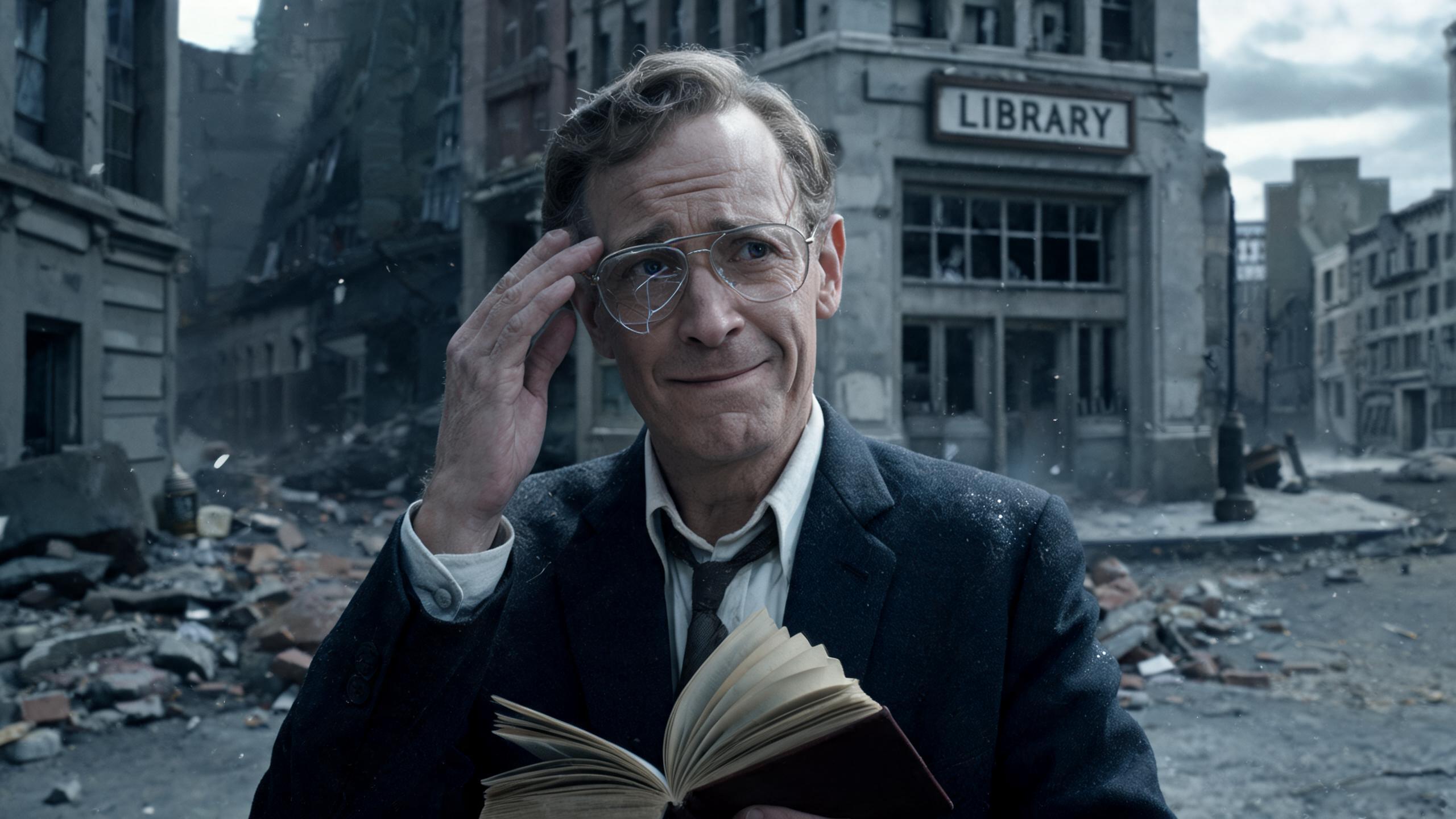
Few television moments have lodged in the public imagination as firmly as the closing scene of Time Enough at Last. The episode centers on Henry Bemis, a mild-mannered bank teller who finds refuge in books amid a life of small humiliations. Written by Rod Serling and anchored by Burgess Meredith's sympathetic performance, the story unfolds with crystalline simplicity before delivering a reversal that remains devastating decades after it first aired.
The episode introduces Henry Bemis as a man who loves reading above all else. By day he endures a job that discourages his habit, by night his wife monitors his time with the printed page. Bemis is not shown as villainous or grandiose. He is ordinary, shy and single-minded. That ordinary quality is crucial. It allows viewers to feel real empathy for him and to understand why the thought of uninterrupted time with books becomes a dream rather than an indulgence.
The narrative turns on two converging forces: a sudden disaster and the private life Bemis has cultivated around books. When a catastrophic event leaves his city in ruins and all other people apparently gone, Bemis emerges from the shelter of a bank vault to discover that he is alone. Surrounded by wreckage but with the public libraries intact, he finally has what he has always wanted: time enough to read. The scene captures an almost childish glee, and Burgess Meredith sells it with a fragile, wide-eyed joy.
Rod Serling crafted the episode with a discipline that matches its central conceit. Dialogue is lean, each line serving character or theme. Serling treats Bemis with compassion rather than caricature, which makes the eventual punchline more than a mere narrative trick. The twist is not inserted for shock alone; it reads as tragic irony, the tragicomic result of a life spent building expectations around a single pursuit. That tonal control is one reason the episode still reads as a masterpiece of compact storytelling.
Production choices magnify the script's impact. The show uses silence and sound to striking effect, allowing the emptiness of a post-apocalyptic world to settle into the viewer. Visuals are economical but evocative: the ruined cityscapes, the toppled bookshelves and the cavernous quiet of the library all reinforce Bemis's isolation. The final image, Bemis staring at his broken glasses, is as simple as it is crushing. It crystallizes the story’s two central notes: the love of reading and the fragility of human plans.
Burgess Meredith's portrayal of Henry Bemis deserves special mention. His performance balances comedy and pathos, making Bemis both endearing and heartbreakingly human. When Bemis first sneaks reading time, Meredith plays the small rebellions with comic timing. Later, his silent delight in the library is both childlike and deeply moving. That layering allows the viewer to inhabit Bemis’s interior life, and to feel the full force of the episode’s final irony.
The episode also illustrates how restraint can heighten emotional payoff. With limited runtime and a simple premise, it avoids needless exposition. Background details about the catastrophe remain intentionally vague, keeping the focus on Bemis's internal experience. That choice preserves the universality of the theme. Whether viewers watch the story in 1959 or today, the emotional logic remains direct and understandable.
Over the years, Time Enough at Last has become one of the most referenced episodes from its anthology series. Its imagery and final beat have been echoed in parodies, homages and academic discussions. Those echoes reflect not just the strength of a single twist but the episode's careful balance of character, theme and performance. It stands as an example of how television can use brevity to create lasting resonance.
The episode’s legacy also shows how a genre series can explore human truths without spectacle. It is not a special-effects showcase or a long moral sermon. Instead it uses a speculative premise to ask a simple question: what happens when a lifelong wish is finally granted, but at a cost? The answer the episode offers is neither ironic for irony’s sake nor sentimental. It is quietly devastating and oddly humane.
In an era when television often stretches stories across seasons, Time Enough at Last reminds viewers that a single episode can be complete and unforgettable. Its economy, humanity and carefully constructed final image combine to produce an experience that lingers. For many viewers, Henry Bemis’s brief taste of paradise and the abrupt loss that follows remain one of television’s most indelible moments.
Roundup: Time Enough at Last endures because it trusts its audience and its central character. Rod Serling’s writing, Burgess Meredith’s performance and deliberate production choices shape a short narrative that feels timeless. The episode does not demand spectacle to prove its point. Its power lies in its clarity of focus and the quiet cruelty of fate. That combination keeps it fresh, disturbing and essential viewing for anyone interested in how television can distill complex feeling into a single, shattering moment.











0 Comments